Resources & Frequently Asked Questions (FAQs)

Trusts and financial planning can be overwhelming – so we compiled a resource page for you. Please contact our Director of Trust Services (ContactUs@MyChoiceTrust.org) with any questions or suggestions to add to this page. We are a resource to you.

Supplemental Needs Trusts: What Are They??

There are a variety options that can help people with disabilities safeguard their assets. To help you compare these options, we’ve included a downloadable chart outlining the key differences and benefits of each.
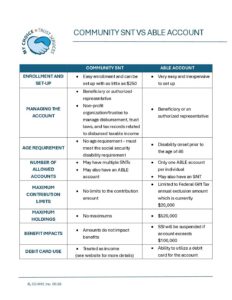
community supplemental needs trust versus able account pdf icon

ABLE Accounts and Community SNTs both offer a way to safeguard resources and preserve financial eligibility for benefits. Each offer unique advantages.

You don’t have to choose one over the other—ABLE Accounts and Community SNTs can be used simultaneously to maximize the resources available and enhance financial flexibility.

supplemental needs trust types flyer pdf icon

There are three main types of Supplemental Needs Trusts: First- Party, Third-Party, and Pooled. Whichever one is best for you depends on your needs and preferences. You can also have multiple different types of SNTs simultaneously.

My Choice Trust Services offers a Pooled Supplemental Needs Trust

Frequently Asked Questions (FAQs)

Community or Pooled SNTs are designed to shelter the assets of individuals with disabilities so the funds can be retained to enrich the beneficiary’s quality of life, while protecting eligibility for means-tested government benefits. The assets held in the trust are not counted towards Medicaid or SSI asset limits. While each beneficiary has their own funds held in sub-trust account, the collection of sub-trust accounts are pooled together for investment purposes, providing greater opportunity for growth, and reducing administrative fees.

New York State residents of any age, with a disability defined by Social Security Law Section 1614(A)(3) [42 USC §1382C(A)(3)].

Pooling of sub-accounts for investment purposes enables highly skilled trustees with industry relevant expertise, the ability to manage funds cost-effectively, with lower administration costs to the Beneficiary. Beneficiaries are eligible at any age, documents are already drafted and approved by Medicaid and SSA, assets are sheltered from Medicaid and SSI eligibility limits, practical for smaller estates.

Individuals with I/DD can qualify financially for means-tested government benefits while sheltering excess income/assets for personal and recreational purposes not covered by benefits, providing financial means for the beneficiaries to plan for future wants and needs, and to live their most meaningful lives.

  • Medical/dental services (not covered by insurance)
  • Private rehabilitation services
  • Supplementary education assistance
  • Television, cable, computer and internet services
  • Entertainment, vacation, and hobbies
  • A vehicle, vehicle service and repairs, or other transportation services
  • Unlimited travel and entertainment (if unable to travel alone, expenses for a travel companion may be allowed)
  • Pre-paid burial expenses
  • Assistive technology/education expenses
  • Caregiver services or personal care attendant
  • Household repairs
  • Mortgage/rent (SSI recipients – see below)
  • Utilities (SSI recipients – see below)
  • Clothing (SSI recipients – see below)

*IF YOU RECEIVE SSI, PLEASE BE AWARE that payments from the trust towards shelter, utilities, or clothing should be avoided as they will be considered “In Kind Support and Maintenance” (ISM) and will reduce SSI payments. Any household good or item purchased by the Trustee for the Beneficiary should not exceed $1,971, as this could be deemed as income to the Beneficiary and could result in and interruption of benefits.

• Mortgage or rent payments

• Property insurance and/or taxes


• Utility bills – gas, electric, heating fuel, water, sewer


• Waste collection


• Credit card bills


• Any items a parent would be responsible for if under the age of 21

SSI is intended to help pay for basic costs of shelter. If one is receiving SSI and accepting assistance for basic shelter needs like the ones listed above from another source, this would be considered “In Kind Support and Maintenance” (ISM) and the SSI benefit may be reduced.

Understanding and differentiating between allowable expenses payable from the SNT and those prohibited can often be confusing. In managing an SNT, it’s essential for the Trustee to steer clear of any actions that could endanger the beneficiary’s eligibility for Medicaid and/or SSI.

Expenses that are not permissible include:

  • Cash or reimbursement to Beneficiary
  • Reimbursement to spouse for rent
  • Gifts or donations (top 3 bullets would count as income and impact income limits)
  • Property expenses not owned by the Beneficiary
  • Life insurance (because it benefits someone other than the beneficiary)
  • Services provided by Medicaid
  • Some medical bills and expenses
  • Overdraft fees and lines of credit
  • Any disbursement after death of Beneficiary

People who qualify for SSI, a public benefit program, are provided with supplemental income to help cover the cost of such necessities as food, clothing, and shelter. It can also be a way for individuals to obtain access to Medicaid.

The Beneficiary, or their authorized representative will need to fully complete the Joinder Agreement (application for enrollment) found in our Document Library on the website.

A completed, signed and Notarized Joinder Agreement along with any supporting documentation (outlined in the agreement) should be mailed to our headquarters or emailed to intake@mychoicetrust.org. Once you are approved, a trust representative will guide you through the steps to fund the account with a minimum of $250 which will cover the $100 one-time enrollment fee and the first month’s administrative fee and still leave a balance.

  1. Once your paperwork is received, a Trust Representative will be assigned to you. They will reach out to review your application and answer your questions. If all documentation is completed in full, and you have provided proof of the qualifying disability, the process should take approximately one week.
  2. The Trust Representative will guide you through funding the account with a minimum of $250. There is a one-time enrollment fee of $100, no renewal fees, and low monthly administrative fees, along with a one-time annual fee of $50 for tax preparation. See the Fee Schedule in our Document Library for more information.
  3. The Trust Representative will review how to make deposits and disbursement requests. Both mail and online options are available.
  4. Please see above FAQs regarding what the trust can and cannot pay for.
  5. Please note, the trust can pay toward a Medicaid irrevocable pre-need funeral arrangement during the lifetime of the Beneficiary. All pre-need funeral arrangement should be made in advance as no payments will be made after the death of a beneficiary. The trust will require a copy of the pre-need contract.
  6. Consistent with Federal Statute, upon the death of a Beneficiary, the account is closed, and all payments will cease, including funeral expenses.
  7. Any remainder funds will remain with the trust to benefit other individuals with disabilities.

Medicaid and SSI Resource Limits


Medicaid Resource Limits 2025 Monthly
Income
Assets
Individual <$1,800 <$32,396
Married Both Applying <$2,433 <$43,781
Married One Applying (Applicant) <$1,800 <$32,396
Married One Applying
(Non-Applicant)
<$3,948 <$157,920


SSI Resource Limits 2026 Monthly
Income
Assets
Individual <$2,073 <$2,000
Married – Combined <$3,067 <$3,000

*SSI does not factor separate limits or benefits for married couples

“Asset Limits” do not include IRAs or 401Ks that are in payout status, your home and the land that is on (as long as you live there or will be returning there), one vehicle per household, household items, personal belongings, a burial fund up to $1,500 or a life insurance policy with a cash value up to $1,500.00, non-refundable pre-paid funeral arrangements, unlimited term life insurance and whole life insurance with a face value of $1,500.00 or less.
*For information on eligibility and qualifications for NYS Medicaid please visit New York State Department of Health or the Office for People with Developmental Disabilities (OPWDD).

*For Supplemental Security Income qualifications, please see SSA.gov.

*For information on Supports and Services available to people with intellectual and/or developmental disabilities in NYS, please visit the Knowledge Center.